
Indian airline industry is expecting to prune its net losses to Rs 3,000-5,000 crore in this fiscal from an estimated Rs 17,000-17,500 crore in FY2023 on the back of improved yields and stable cost environment, credit ratings agency ICRA said on Tuesday. At the same time, ICRA also estimated that domestic air passenger traffic will expand by 8-13 per cent each in FY2024 and FY2025. The rating agency has also maintained its stable outlook on the industry in view of healthy passenger traffic growth, improved yields and a stable cost environment.

Jet fuel or ATF prices were on Thursday were cut by a steep 4.5 per cent, the first reduction in rates in six months.

According to the package, the dues will be cleared in six monthly instalments by March 2009. Current ATF purchases will get 90 days' credit, supported by bank guarantees. Also, jet fuel price revisions will henceforth happen every fortnight. Praful Patel on Thursday admitted in the Lok Sabha that it may take another two months to make the recently-opened third runway at the Delhi airport fully operational.

Jet fuel prices on Wednesday were cut by 1.3 per cent -- the first reduction after 10 rounds of price hikes -- on softening international crude oil rates. Simultaneously, prices of commercial LPG - used by business establishments such as hotels and restaurants - were reduced by Rs 135 per 19-kg cylinder. The price of aviation turbine fuel (ATF) -- the fuel that helps aeroplanes fly -- has been reduced by Rs 1,563.97 per kilolitre, or 1.27 per cent, to Rs 1,21,475.74 per kl (Rs 121 per litre) in the national capital, according to a price notification of state-owned fuel retailers.

The government was also working on a package to promote connectivity and airports in the North Eastern states
ATF or jet fuel price has been cut marginally while rate of non-subsidised cooking gas LPG has been hiked by Rs 27.50 a cylinder.
Despite the best ever quarterly net profit of Rs 3,091 crore during April-June of financial year 2023-24 (Q1FY24), challenges are mounting for InterGlobe Aviation-run IndiGo in the near term, said analysts. Given this, most brokerages have retained their ratings from 'buy to underperform', as well as their target price for the stock. For instance, Motilal Oswal Financial Services has retained its 'neutral' rating on the scrip as it believes the low-cost airline is facing teething issues at present.

Capa lauded govt's efforts in rescuing SpiceJet.

Apple's ambitious strategy to expand iPhone exports, shift more production from China to India at a faster pace, and grow its domestic market hits a Trump-sized roadblock.

Despite the increase, at Rs 64.32 per litre ATF costs less than petrol and diesel.


In reply to a question in Rajya Sabha as to whether Air India was eyeing Rs 300 crore (Rs 3 billion) saving via direct fuel import, the Minister said, "AI has not yet decided about import of Air Turbine Fuel directly.

Adding petrol and diesel to GST was a challenging task due to their significant role as revenue generators for both the central and state governments.

Lower crude oil costs and higher marketing margins are expected to raise the fortunes of oil marketing companies (OMCs) in the first quarter (Q1) of 2023-24 (FY24), while city gas distribution (CGD) companies could also benefit from lower spot prices of liquefied natural gas (LNG). However, in a break from the past, growth trends are expected to diverge for various segments within the broad energy sector. Analysts expect the earnings from gas production to go down for upstream national oil and gas companies such as Oil and Natural Gas Corporation (ONGC) and Oil India (OIL) due to the introduction of the new domestic gas pricing regime on April 1. After showing steep losses over the first half of 2022-23 (FY23), the marketing margins of OMCs have steadily recovered in four months.

Upbeat high-frequency indicators and consumer confidence show that Indian economy continues to forge ahead, emerging out of shackles of pandemic, said an article on the state of economy published in RBI Bulletin on Wednesday. The recovery is spearheaded by an uptick in private investment through November-December alongside a turnaround in bank credit offtake and high capex from the government sector (Centre and states). In conjunction, the employment situation has brightened, said the article written by RBI officials.

Coordination between defence and civilian authorities has freed up airspace for commercial airlines in India, resulting in routes becoming shorter and costs coming down, apart from mitigating pollution. "Due to various restrictions of the military, only about 58 per cent of the Indian airspace was being utilised. It is close to 70 per cent now," said an official of the Airports Authority of India (AAI). Officials of the AAI said to date 119 routes had been shortened. Sources said since December 2020 the cumulative savings of airlines had been close to Rs 200 crore while there was a reduction in emission of around 45,000 tonnes of carbon.
Commerce Minister Kamal Nath on Friday announced that jet fuel supplies to long-distance flights of international carriers would be treated as exports.
Currency depreciation also hits earnings of all domestic carriers
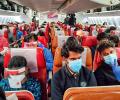
Domestic air passenger traffic remained 44 per cent lower in the April-December 2021 against the corresponding period of FY20, but saw a jump of 52 per cent year-on-year to 111 lakh in December 2021, according to rating agency ICRA. The total domestic passenger traffic had stood at 73 lakh in December 2020, according to a report by the rating agency. It also said that the emergence of new coronavirus variant and reactionary restrictions impacting air travel remain near term-challenges for the airline industry.

AirAsia, which is a joint venture between Tata Sons Ltd, TelestraTradeplace currently flies from Bengaluru to Chennai, Kochi, Goa and vice versa.

Air fares to go up as ATF price is hiked by 8.2%.

The Indian economy requires a Rs 3 lakh crore fiscal stimulus, including cash transfer to households through Jan Dhan accounts to spur economic growth amid the pandemic, industry chamber CII said on Thursday and pitched for appointment of a 'Vaccine Czar' for speedy vaccination coverage. CII president T V Narendran also said the chamber expects GDP to grow at 9.5 per cent in 2021-22 as the strong growth in the second half of the fiscal year will be supported by robust external demand and large-scale coverage of vaccination, allowing resumption of economic activity. He also advocated for appointment of a "Vaccine Czar" for speedy vaccination coverage.

Consumption-related stocks, such as hotels, and quick service restaurants (QSRs), have been hitting the ball out of the park ahead. On the other hand, the Miss World Pageant scheduled for later this year in New Delhi, too, could provide some tailwind to these stocks, especially hotels and aviation. However, analysts suggest investors put their best foot forward and buy these counters only on a decline given the recent rally and economic headwinds.

This is the second straight increase in jet fuel rates in as many months.

Air India on Thursday increased the fuel surcharge component in fares on several routes.

The rupee depreciation will work in favour of students who are currently studying in the US and plan to secure a job that pays in dollars.
'The levy proposed to be charged on air tickets for regional connectivity fund would marginally increase cost.'

Hit by the third wave of the COVID-19 pandemic and soaring fuel prices, airlines are flying towards record losses with a likely loss of a whopping Rs 20,000 crore for the full fiscal year, warns a report. The airlines are flying towards their steepest-ever net loss of over Rs 20,000 crore this fiscal, which will be 44 per cent more than Rs 13,853 crore they bled last fiscal, Crisil said in a report. This will push back the industry's recovery beyond fiscal 2023, the report based on three large listed airlines--Indigo, Spicejet, and Air India--which together command 75 per cent of the domestic traffic, warned.

Amid record-high fuel prices, Finance Minister Nirmala Sitharaman on Monday said there is no proposal as of now to bring crude oil, petrol, diesel, jet fuel (ATF) and natural gas under the Goods and Services Tax (GST). When the GST was introduced on July 1, 2017, amalgamating over a dozen central and state levies, five commodities - crude oil, natural gas, petrol, diesel, and aviation turbine fuel (ATF) - were kept out of its purview given the revenue dependence of the central and state governments on this sector. This meant that the central government continued to levy excise duty on them while state governments charged VAT. These taxes, with excise duty, in particular, have been raised periodically.

With crude oil price crossing $100 per barrel mark, the airlines have begun to pass some of the cost on to the consumer to meet the increased air turbine fuel expenses, and asked the government to take steps to reduce the cost of aviation fuel.
Air fares up 20-30 per cent as operating costs mount.

It is the seventh reduction in jet fuel rates since August
The windfall taxes on domestic crude oil production and fuel exports will generate close to $12 billion (Rs 94,800 crore) for the government in the remainder of the current fiscal while trimming profits of firms such as Reliance Industries Ltd and ONGC, Moody's Investors Service said Tuesday. On July 1, the government imposed windfall gain taxes on the export of petrol, diesel and aviation turbine fuel (ATF), and on the domestic production of crude oil. It has also mandated exporters to meet the requirements of the domestic market first.
Rather than minimising competition, the airlines competed head-on in several routes and tried at one time to grab the market share at the price of profitability. The study, sponsored by Observer Research Foundation, asks government to ensure a level playing field by providing various tax reductions and concessions.
In a much-needed relief to cash-strapped airlines, this is the second straight monthly reduction in rates and the biggest single cut ever.

Brokerages lowered their earnings estimates following muted results in Q1FY24. While analysts remain optimistic about the stock's medium-term prospects, they highlight near-term concerns stemming from lower realisations due to changes in the product mix and margin pressures resulting from new plane additions.
The growth, however, may not indicate a major revival of economic activity.

Average monthly GST collection rose from Rs 90,000 crore during the first year of its implementation -- 2017-2018 -- to Rs 1.68 trillion during 2023-2024, representing an 87 per cent rise.

'I would not suggest buying these stocks in the dip, as the upside in profit is dented without a safety net for a rainy day.'

Strong passenger growth will help domestic airlines improve their top line and margins.
